Showing posts with label carbon. Show all posts

Wednesday, 12 May 2021

Climate Impact of Clicking Cookie Preferences

Climate Impact of Clicking Cookie Preferences

Annoying and Bad for the Planet

It is very annoying having to click on Cookie Preferences nags for every website you visit. And it this pointless exercise is also killing the planet, releasing approximately 18,000 tons of CO2 to atmosphere every year, in the UK alone. 

Every interaction with you smart gadget, or PC or Macintosh, uses energy. At present a percentage of that energy comes from fossil fuel. 

Every time you select you cookie preferences, this triggers a series of operations to be run on a server somewhere in the "cloud", using energy as it does so. 

Estimating Climate Change Impact of GDPR

GDPR is a piece of legislation that was passed to protect users data. However, in practice this means 99% of website just ask our permission (the cookie preferences clicking thing) and then take our data anyway. 

If you go to advanced options and select preferences individual it would more than double the amount of  time to took to search things on the internet. 

Text Messages Example

Now to send a text message, which is a fairly basic text based interaction over a network, the carbon equivalent footprint is 0.014gCO2e. Not a huge amount but on an annual global  basis this means the the carbon footprint of text messages is 32,000 tonnes/CO2e.

32,000 tonnes/CO2e would cover all emissions for 2600 UK citizens, that foods, travel, heating, purchases etc. so no small amount. 

How Many Clicks 

There are 3.5 billion search queries every day in UK. If each of these simple text based interactions have the same carbon footprint as a text message (which is quite likely). Then we are release 49 tons of carbon dioxide a day, that is approx 18,000 tons of CO2e a year released to atmosphere.

If we consider that most of the time these interacct allow website owners to then go on and use our data how they see fit, rather then actually protecting us, I would suggest this is a colossal waste of carbon, which we badly need to stop emitting. 

Ideas

Thanks to GDPR we now have to opt in by default, so that big data can hoover up our tasty information. This means we have to click to opt in on nearly every website we visit. Perhaps we should opt out instead. 

Some website it is useful to have cookies "recognise you" oin your return. Internet banking for example, on these sites there could be a button (on the page not on a pop up) saying "click here to enable cookies". That way 90% of these pointless interactions would be immediately erased. Saving 10's of thousands of tonnes of CO2 in the UK alone. 

Tuesday, 30 October 2018

Why does organic milk have a higher carbon footprint?


Why does organic milk have a higher carbon footprint?


The Oxford English Dictionary defines a carbon footprint as “the total amount of greenhouse gases produced to directly and indirectly support human activities, usually expressed in equivalent tons of carbon dioxide (CO2).”

So why does organic milk have a higher carbon footprint?


Lower yields.


It takes 80% more land to produce one unit of milk than conventional production does. Whilst energy is saved by the avoidance of synthetic fertiliser applications, this is actually being offset by the significantly lower yields and greater mechanical field inputs. These low yields create a negative environmental knock-on effect because an organic dairy farm needs a larger area to produce less milk than a conventional farm.

Higher on-farm energy consumption.


The energy consumption per functional unit in the on-farm process is around 20% higher on an organic model than it is on a conventional one.
On-farm primary energy use in the organic system is 15.8% 5 higher than the conventional system, while organic milk required 33.9% 6 more fuel per thousand litres of milk.
Furthermore, the organic systems requires approximately a third more man hours than conventional systems. The longer man hours include machinery hours and therefore creating a greater consumption of fossil fuels, in the form of diesel and electricity, increasing organic milk’s carbon footprint.

Synthetic vs Organic Fertilizer.


The organic system can require the spreading of up to 20 tonnes/ha of manure, and the average conventional farm applies around 1100 kg/ha of synthetic fertiliser That is around 20 times the weight difference in transport and management every year. This figure is staggering when you consider the difference in power and machinery hours needed to load, transport and spread up to 20 t/ha of manure compared to a meagre 1.1 t/ha of synthetic fertiliser, having implications on fossil fuel consumption and the carbon footprint. Furthermore, in many cases when an organic farm has insufficient solid manure from its own cows it is actually forced to import organic manure from other organic farms.

Higher methane emissions.


Methane gas is twenty three times more potent than carbon dioxide. It is estimated that cows in the UK alone produce up to 500 litres, per cow, of methane every day, a figure so high that they account for 3% of the UK’s total greenhouse gas emissions.
Organic milk’s methane contribution is 18% higher than conventional milk. In the UK showed the figure to be 70% methane in the organic system, compared to 52% on the conventional system.
The reason for the higher production of Methane is that organic cows eat more roughage, this takes to longer to digest than the diet of an animal in an intensive system. Grass is rich in cellulose and other tough components; symbiotic bacteria living in her gut help break down this tough food. Unfortunately, these bacteria emit huge amount of methane while doing this job.  Since and organic cow needs more time to digest, she produces more methane than a conventional cow.

Supplementary Organic Cattle Feed.

A commercial dairy cow cannot exist solely on a grass fed diet. The additional protein requirements for organic dairy cows create a large carbon footprint in themselves, as the produce cannot be grown in temperate/cool climates. The standards set by the UK’s organic bodies forbid the use of GMO feeds which would lower the amount of carbon used.  Something that is often overlooked is that Soya meal, a key protein rich ingredient is sourced from farms in Asia, South America and the US. These imports are fuelling slash and burn techniques and further deforestation in areas of South America. This shatters the food mile argument from much further down the supply chain, before the manufacturing process of feeds begins and even before feed is synthesised into milk. Whilst Soya meal is not present in all cattle feeds, the environmental impact of long distance goods importation must not be underestimated.


SOURCES:


Does the carbon footprint of organic milk production negate its environmental benefits?
Henry J.W. Robertson Oxford Brookes University

What's the environmental impact of milk?

Is Organic Milk Better for the Environment ? Not Really …


Waste Transfer Station Permit

Google Maps Ranking

Friday, 9 December 2016

Carbon Footprint of Cycling per Mile

Carbon Footprint of Cycling per Mile - Intro


Many basic graphs that compare cycling with other modes of transport rate cycling as "zero" impact.

This is fine as like walking cycling is one of the lowest carbon forms of transport available. However, when we consider the fuel that the cyclist uses i.e. the food they eat in order to gain the calories burnt in cycling does this change anything?

Carbon Footprint of Cycling per Mile - grams of CO2 per mile for a Car

Our benchmark for our CO2 per mile will be that described in "The Ecologist" of 168g/CO2/mile, for a car. 


Carbon Footprint of Cycling per Mile - grams of CO2 per mile for a Bicycle

Now consider the calories burnt cycling 1 mile on a Bicycle, this varies base don the speed and the weight of the rider, but a conservative figure might be 50 calories per mile. How does the cyclist get those calories . . . ?


Eating meat, is carbon intensive. . . a meat rich diet creates over double the CO2 footprint of a vegan diet. 


So if we we were to cycle 1 mile on a vegan diet, vegetarian or "all in" dirt we would create different emissions. 

gCO2 per mile by Diet 


So if we then apply our 50 calorie per mile number to the CO2 per calorie we get:

CO2 per mile by diet - Bicycle


Remember a mile in a car creates 168 gCO2, from burning fossil fuels.

Carbon Footprint of Cycling per Mile - Making a Comparison


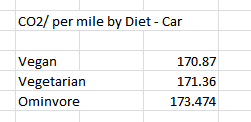
Now the average person burns 68 calories per hour whilst sitting. On a single carriage way the driver of a car will burn 1.4 calories per mile. So we can add this CO2 burden to that produced by the fuel. Sp if we add in the metabolic co2 impacts we get. 

CO2 per mile by diet - Car

Carbon Footprint of Cycling per Mile - Conclusion

Cycling would appear to only save carbon if you eat a low meat diet. Please note this post is restricted to operational impacts only, and does not consider manufacturing impacts or infrastructure impacts. 


Tuesday, 24 November 2015

Bank of England Boss: "Catastrophic Climte Risks"

Bank of England Boss: "Catastrophic Climate Risks"


James Carney the Bank of Englands Boss has warned of catastrophic climate risks, and the need to protect the UK's economy from the cumulative impacts of climate change.


The Governor of the BoE raised these concerns during a London dinner event held for bankers. But his views are backed up with reporting carried out by the Bank of England.

He has warned that many of or top businesses are in "carbon rish" sectors and that the the required decarbonsitaion of the economy could lead to to a shift, with these corner stone businesses becoming less sucessful.

Investment is green tech needs to quadrupedal said Carnry, and that it could no longer afford to be considered a niche market.

Watch the video of the speech below.


Full details at Bank of England.

Environmental Consultants London

Tuesday, 6 September 2011

A National Heat Grid?

By using heat from buring wastem, and steam to gnerate eleticity, you can recover lots nmore energy. However there will be distibution probelms.

Thermal Treatment seems to me at least the most “fuss free” system for dealing with waste. However, I believe it should be applied on a small scale for maximum benefit, in this way, it would be possible to cut down of waste miles and utilize the heat more widely, which is a much more efficient way to use the energy created. Electricity generated would be fed in to the grid, but a new “grid” would have to be constructed for the distribution of heat. However, numerous small scale plants would mean more opportunity for localized use of heat (there for less pipe work etc.). No matter how good this system would be, it will not happen so long as public consultation remains such a dominant force in the planning process.

Environmental Consultants Bristol
Environmental Consultants Exeter

Monday, 25 April 2011

Carbon Accounting and Emisssions Factors. Whats that?

Carbon Accounting: As I understand it this is the umbrella term for embodied carbon and operational carbon. It depends on what project you are building as to which is the most important consideration. For a pumping station you may which to consider lavishing you budget on some efficient pumps, as you operational carbon use will be high otherwise, in comparison spending an unnecessary amount on low carbon building materials will only save small amounts, so it is more efficient use of money, in terms of carbon (and in the case money) to put you budget in to efficient pumps. A store shed on the other hand will have low operational carbon, so green building materials may be a viable option here.

Emissions Factors: These are the basis of all carbon accounting; they tell you how damaging a process is in term of emissions per unit volume. It is important to use a standardized Emissions factors set, and a presume this is why, DEFRA have released a booklet (downloadable) with lots of emissions factors in it. However, so emissions factors are still on the drawing board, SWW get some of theirs from research groups.

Environmental Consultants
Environmental Permitting
Desktop Study
Sustainability Consultants
Compliance Consultants

Friday, 8 April 2011

Evolution = Less Efficiency

What do we really need? (Based on Maslow Hierarchy)

-Water (3 liters a day)
-Food (1500 calories a day)
-Shelter (A tent and some animal firs)

What do we think we need?

-Water (100 liters a day) – (19/01/10: Not counting embodied water in products)
-Food (Three Meals, Hot Drinks, Snacks – 2500 calories a day and more)
-Shelter (Three bedroom semi detached)

. . . . . .and

2 Cars
Annual Holiday
Education
An over lavish Christmas etc etc etc

So the bottom line is that most people their lives about as far away from being sustainable, as you could possibly imagine, and I suppose (to get back on track) people’s needs drive industry to provide what it does.

Environmental Consultants Somerset
Environmental Permitting
Desktop Study

Friday, 1 April 2011

Carbon payback scheme areOK?

Although carbon pay back schemes it brought about a decrease in growth for developing countries, that LDCs (Lesser Developed Countries) really still benefited from all of the technology of MDCs and and such there should not be complaints, we polluted our environment and the globe, and that's a shame but it lead to development, and LDCs get the benefits of this development, some might say that people in LDCs for example Botswana want to live a simple life and not to ruin the country by westernising it, but they probably drives a 4x4.

I have met a number of communists in my time, all who say "I'm a communist at heart". . . . they all live in big houses. Stick them in a tiny flat eating lard a cabbage, in Moscow in 1960, and then see if they want to be a communist, its the red wine moment as some call it. . . . .wouldn't it be nice if the world was cadbury.

The fact is people want. They want cars fridges, a nice house with a blender and something to put in that blender, these wants will never stop, so lets get less people on the planet. I think the one child policy in china is a bit harsh as be an only child may have negative psychological affects, a two child policy would stabilise the population and possibly reduce it slowly as some couples would choose to have one, the Chinese guys found it very strange that we get paid for having kids in this country. We have just had our fist child and we get £160 a month from the government and and tax breaks, now that's not a lot to my wife and I but, for a mother who is on social benefit or a low income family it is an incentive to have more kids, fact, this needs to stop. Also these lower social economic groups are generally less well educated, and large families put strain on parenting time which can only lead to social decline.

Environmental Consultants Devon
Environmental Consultants Somerset
Which is the greenest car?

Wednesday, 16 February 2011

Reflections on an Iron Age Fort

The trials and tribulations undertaken by iron age man, were most impressive on
viewing the bund that surrounded the site of the iron age fort, such was its size it
would have a taken a JCB perhaps a week to construct it, I estimate that it would
have been in the region of 3600 m3 of soil and rock, that probably about 8000
tones of soil all moved with a hollowed out antler. Whilst I was a laborer my best
effort was 8 tones in one day, but that was using a shovel and wheel barrow, and
the substance was sand which is easy to shovel, based on that it must have
taken them at the very least 1000 man days to accomplish, probably double that,
so it really was a prolonged effort, perhaps over ten years or so.

One thing that struck me is how we (humans) have complicated life so much, we
were once happy with a willow grove to make most of our containers and
baskets, clay for pots and cups, now we make them from refined oils at great
cost to the environment before shipping them around the world, and not even
reusing them, straight in the bin! We’ve gone mad. There was this film I was
watching I while back “the gods were mad” in this a primitive tribes people, find a
coka cola bottle dropped out of a plain it becomes the thing to have in their
society, a wondrous thing. Yet we throw away jam jars and plastic bottles all the
time and in the next step we are buying a tuper ware container to keep things in. Madness.

Recycling

Lower your Carbon Foot Print

Eat Greener Food

Environmental Consultants